Spectacle Blinds, Spades & Spacers for Oil & Gas and Industrial Applications.
LINE BLANKS
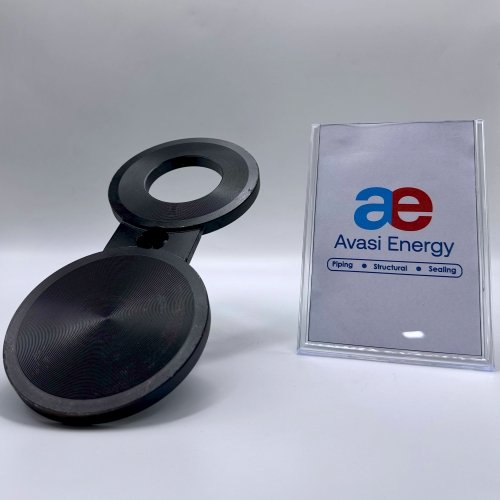
Line Blanks for Positive Piping Isolation.
Avasi Energy supplies line blanks in Sabah and Malaysia for positive isolation requirements across oil & gas, petrochemical, energy and process piping systems.
Our sourcing scope includes spectacle blinds, paddle blanks or spades, and paddle or ring spacers, supplied according to the required size, pressure class, material, flange facing, dimensions, applicable standard, inspection and documentation requirements.
From standard ASME B16.48 line blanks to selected project-specific requirements, Avasi Energy works with suitable manufacturers and supply partners to coordinate products against the customer’s piping specification and isolation requirements.
POSITIVE ISOLATION YOU CAN SEE.
Physical Separation Within the Piping System.
Line blanks are installed between mating flanges to provide either a solid physical barrier or an open flow path, depending on the component installed.
Unlike a valve, a line blank provides a physical isolation element within the flanged joint when the solid blank is correctly installed.
They are commonly specified for activities involving:
- Maintenance
- Shutdowns & Turnarounds
- Equipment Isolation
- Commissioning & Decommissioning
- Plant Modifications
- Process Segregation
- Testing or Project-Specific Isolation Requirements
Selection and use must always follow the applicable engineering design and the facility’s approved isolation, depressurisation and safety procedures.
A line blank is more than a plate. It is part of the piping isolation philosophy.
OUR LINE BLANK RANGE.
Three Configurations. Two Operating States.
Spectacle Blinds
Open or Closed in One Connected Component.
A spectacle blind — also known as a figure-8 blind — combines a solid blank and an open spacer ring into one connected component.
One side provides the solid isolation element, while the other maintains an open flow path when placed in the corresponding position.
This configuration can make the open or closed condition visually identifiable and is widely used where piping systems require planned isolation changes.
Spectacle blinds should be selected according to:
- Size / NPS
- Pressure Class
- Material
- Facing
- Thickness
- Mating Flange Standard
- Service Conditions
- Project Specification
Paddle Blanks / Spades
A Separate Solid Isolation Component.
A paddle blank, commonly referred to as a spade or spade blind, is a separate solid plate installed between mating flanges where physical flow isolation is required.
Unlike the connected construction of a spectacle blind, the paddle blank is a standalone component.
It is normally paired with a matching paddle spacer so that the required flange spacing can be maintained when the line is returned to its open configuration.
Separate spade-and-spacer arrangements may be specified for larger or heavier configurations, or wherever required by the project isolation philosophy.
Paddle Spacers / Ring Spacers
Maintaining the Open Flow Path.
A paddle spacer — or ring spacer — is the open counterpart to a paddle blank.
The spacer maintains the required separation between mating flanges while providing an open bore through the line.
For a matched blank-and-spacer arrangement, the spacer thickness should correspond to the applicable blank design so that the flange spacing remains compatible when one component replaces the other. Manufacturer guidance for ASME B16.48 arrangements reflects this matched-thickness principle.
SPECTACLE BLIND OR SPADE & SPACER?
Same Isolation Principle. Different Configuration.
| Requirement | Spectacle Blind | Spade & Spacer |
|---|---|---|
| Construction | Blank and spacer connected together | Two separate components |
| Closed condition | Solid portion positioned in line | Spade / paddle blank installed |
| Open condition | Open ring positioned in line | Matching spacer installed |
| Visual identification | Connected figure-8 configuration | Separate handled components |
| Typical selection | Where connected configuration suits operation and handling | Where separate components are preferred or specified |
| Key specification | Size, class, facing, material, standard | Size, class, facing, material, matched thickness |
The correct arrangement should follow the piping design, handling requirements, isolation philosophy and project specification.
ASME B16.48 LINE BLANKS
Built Around the Current Line Blank Standard.
The current ASME B16.48 standard covers operational line blanks for installation between ASME B16.5 flanges.
Its official scope includes:
- NPS ½ through NPS 24
Pressure Classes:
- 150
- 300
- 600
- 900
- 1500
- 2500
The standard addresses areas including pressure-temperature ratings, materials, dimensions, tolerances, marking and testing.
For Avasi, this should be the core standard reference for applicable line blank requirements.
Applicable editions ultimately follow the customer’s project specification.
STANDARD OR CUSTOM?
Know Where the Standard Scope Ends.
ASME B16.48’s current official dimensional scope is NPS ½ through NPS 24.
For requirements outside the applicable standard scope — such as certain large-diameter, non-standard thickness, special facing or project-specific configurations — the product may instead require manufacture against an approved project drawing, engineering design or other applicable specification.
Avasi Energy can coordinate such enquiries through suitable manufacturers, subject to technical review.
Standard where applicable. Engineered where required.
FLANGE COMPATIBILITY MATTERS.
The Line Blank Must Match the Joint.
A line blank is installed within a flanged connection, so flange compatibility is fundamental.
The enquiry should clearly identify:
Nominal Size
- The line blank must match the required piping and flange arrangement.
Pressure Class
- The required class must correspond to the mating system and applicable specification.
Facing
- Requirements may involve configurations compatible with:
- Raised Face — RF
- Ring Type Joint — RTJ
- Flat Face or other project-specific arrangements, where applicable
- Requirements may involve configurations compatible with:
Dimensions & Thickness
- Line blank dimensions and required thickness depend on the applicable standard, size, class, material and project requirements.
Gasket Interface
- The gasket arrangement must remain compatible with the flange and line blank configuration.
A matching NPS alone does not define the correct line blank.
MATERIAL SELECTION
Material Follows the Service.
Line blanks may be produced from plate or forged material depending on the design, standard, size, service and manufacturer route.
Typical project requirements can include:
Carbon Steel
- Requirements may include carbon-steel plate such as:
- ASTM A516 / A516M Grades 60, 65 or 70
- where appropriate to the design and project specification.
- ASTM A516 covers carbon-steel pressure-vessel plate in grades including 60, 65 and 70.
- Requirements may include carbon-steel plate such as:
Stainless Steel
- Project requirements may include materials such as:
- 304 / 304L
- 316 / 316L
- to the applicable plate or forging specification.
- Project requirements may include materials such as:
Duplex & Super Duplex
- Selected corrosive, offshore and process services may require project-specified duplex or super-duplex materials.
Alloy & Special Materials
- Chrome-moly, nickel-alloy, high-yield or other project-specific materials may be sourced where required and supported by appropriate manufacturers.
Forged Material Requirements
- Where a forged construction is specified, material requirements may involve applicable forging specifications such as carbon, alloy, stainless or duplex grades.
Important: material grade must follow the engineering and project specification rather than being selected solely from a supplier catalogue.
SOUR SERVICE & SPECIAL APPLICATIONS
When Isolation Components Require Additional Controls.
Oil & gas line blank requirements can involve additional material or quality requirements depending on the operating environment.
These may include:
- H₂S / Sour Service
- Low-Temperature Service
- High-Temperature Service
- Offshore / Marine Environment
- Corrosive Process Conditions
- Hardness Restrictions
- PMI Requirements
- Additional NDE
- Special Surface Finish
- Corrosion Allowance
- Project-Specific Marking
- Special Identification / Tagging
Avasi Energy coordinates these requirements according to the customer’s material requisition, piping class and project specification.
Do not automatically describe a line blank as NACE compliant solely because of its base material. Suitability should be supported by the applicable material condition, testing and documentation requirements.
OPEN OR CLOSED SHOULD BE IDENTIFIABLE.
Clear Identification Supports Correct Line Status.
For paddle-type line blanks, external identification helps distinguish between a solid blank and an open spacer.
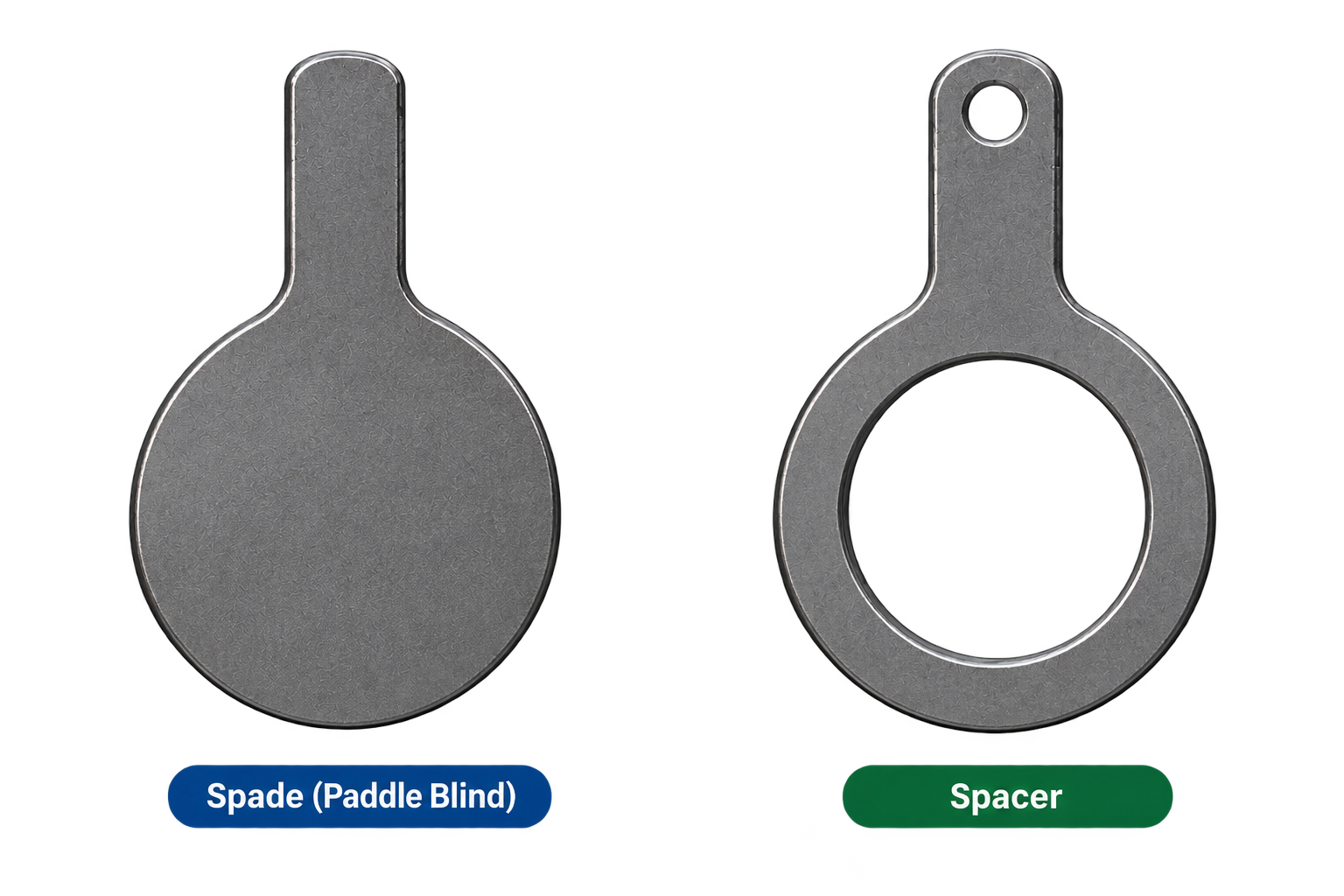
ASME B16.48 practice provides distinct paddle-handle identification: the solid paddle blank has a solid handle, while the spacer uses a visible indicator opening. This allows the installed component to be distinguished externally.
TRACEABILITY MATTERS.
Know What Is Installed in the Line.
Depending on the project specification and agreed supply scope, line blank identification and supporting documentation may include:
- Manufacturer
- Material Grade
- Heat Number
- Type
- Size / NPS
- Pressure Class
- Facing
- Applicable Standard
- Thickness
- Product Marking
- Project Tag Number, where required
- Material Certification
- Inspection Records
For shutdown and maintenance applications in particular, clear identification can also support material verification and project documentation.
Correct isolation starts with a clearly identified component.
TESTING, INSPECTION & DOCUMENTATION
Confidence Beyond the Line Blank.
Avasi Energy can coordinate inspection and documentation requirements according to the applicable specification, manufacturer capability and project requirements.
Depending on the supply scope, these may include:
- Material Test Certificates — MTC / MTR
- EN 10204 3.1 / 3.2 Certification, where specified
- Chemical & Mechanical Test Results
- Dimensional Inspection
- Thickness Verification
- Facing / Surface Finish Inspection
- RTJ Groove Inspection, where applicable
- Positive Material Identification — PMI, where specified
- Hardness Testing, where required
- Ultrasonic or Other NDE, where specified
- Third-Party Inspection — TPI
- Certificates of Conformity / Compliance
- Inspection & Test Plan — ITP
- Approved Drawing
- Manufacturing Record Book / Data Book, where required
The inspection and testing package should be based on the applicable design standard and actual project specification.
LINE BLANKS ARE NOT BLIND FLANGES.
Similar Purpose. Different Piping Component.
Line Blank
Installed between two mating flanges and used as part of a piping isolation arrangement.
Examples:
- Spectacle Blind
- Paddle Blank / Spade
- Paddle Spacer
Blind Flange
A flange without a central bore that terminates a flanged piping or equipment connection.
Both may be associated with closing a piping system, but they have different designs and installation arrangements.
Need a Blind Flange? Explore FlangesTECHNICAL ENOUGH FOR ENGINEERING. CLEAR ENOUGH FOR PROCUREMENT.
Confidence Beyond the Line Blank.
Engineering teams need confidence that the line blank matches the flange system, pressure class, material and isolation requirement.
Procurement teams need a product description that can be quoted and compared without ambiguity.
Avasi Energy brings the two together by focusing on:
- Correct Type
- Correct Size & Class
- Correct Facing
- Correct Material
- Correct Documentation
Physical Isolation. Clear Specification. Documented Supply.
WHAT TO SEND US FOR AN ACCURATE LINE BLANK RFQ
Help Us Quote the Correct Line Blank.
Product Type
- Spectacle Blind / Figure-8
- Paddle Blank / Spade
- Paddle Spacer / Ring Spacer
Connection Details
- Size / NPS
- Pressure Class
- Flange Standard
- Facing — RF / RTJ / FF / Other
Material
- Material Specification
- Material Grade
Configuration
- Standard ASME B16.48
- or
- Project Drawing / Custom Requirement
Special Requirements
- Corrosion Allowance, where required
- Surface Finish
- Special Tagging / Marking
- Sour-Service Requirement
- Testing / Inspection Requirements
- Documentation Requirements
- Third-Party Inspection
- Approved Manufacturer Requirement, if applicable
- Quantity
- Required Delivery Date
Where available, attach:
- RFQ
- Piping Class
- Material Requisition
- Line List
- Drawing
- Project Specification
Example Ordering Descriptions
Spectacle Blind
Spectacle Blind, NPS 6, Class 300, RF, ASME B16.48, ASTM A516 Gr.70
Paddle Blank / Spade
Paddle Blank / Spade, NPS 4, Class 600, RF, ASME B16.48, SS316L
Paddle Spacer
Paddle Spacer, NPS 4, Class 600, RF, ASME B16.48, SS316L
Examples only. Final product description must follow the applicable project specification.
FROM REQUIREMENT TO DELIVERY
A Focused Supply Process.
- Review
- We review the required pipe specification, grade, dimensions, quantity, testing and documentation requirements.
- Source
- Suitable manufacturers and supply sources are identified according to the stated requirement.
- Technical Compliance
- The proposed pipe is reviewed against the agreed technical and commercial scope.
- Inspection & Documentation
- Required certification, testing and inspection documentation is coordinated where included within the supply scope.
- Delivery Coordination
- Final documentation and delivery requirements are coordinated through order completion.
Specification Reviewed. Supply Coordinated. Documentation Aligned.
SUPPORTING SABAH’S INDUSTRIAL REQUIREMENTS
Based in Sabah. Connected Beyond Sabah.
Avasi Energy is based in Kota Kinabalu, Sabah, supporting pipe and piping-material requirements for customers, projects and industrial operations in East Malaysia.
Our local presence is supported by access to manufacturers and supply partners in Malaysia and internationally, allowing us to coordinate requirements according to project specifications rather than restricting customers to a single source or product range.
This positioning is increasingly relevant as Sabah’s OGSE ecosystem develops. PETRONAS reported in February 2026 that contracts secured by recognised Sabah-based OGSE vendors had grown substantially since 2021.
We support requirements associated with:
- Oil & Gas
- Petrochemical & Process
- Energy
- Offshore & Onshore Projects
- Maintenance & Shutdowns
- Brownfield Modifications
- Replacement Requirements
Local Presence. Wider Sourcing Capability.
COMPLETE THE FLANGED JOINT
Need the Matching Flanges / Gaskets / Stud Bolts?
Avasi Energy also supplies:
Pipe FittingsElbows, tees, reducers, caps, forged fittings and branch connections.
FlangesWeld neck, blind, slip-on and other project-specified flange configurations.
GasketsSpiral wound, RTJ, kammprofile, non-metallic and selected industrial sealing solutions.
PipesCarbon steel, stainless steel, alloy and project-specific piping requirements.
Stud Bolts & FastenersRestriction OrificesFREQUENTLY ASKED QUESTIONS
What is the difference between a spectacle blind and a spade?
A spectacle blind combines the solid blank and open spacer in one connected figure-8 component. A spade or paddle blank is a separate solid isolation component normally used with a separate matching spacer.
What does a paddle spacer do?
A paddle spacer provides an open flow path while maintaining the flange separation required by the corresponding line-blank arrangement.
What sizes does ASME B16.48 cover?
The current ASME B16.48 standard covers operational line blanks from NPS ½ through NPS 24 for installation between ASME B16.5 flanges in specified pressure classes.
Can Avasi supply line blanks larger than NPS 24?
Avasi can coordinate selected large-diameter or custom line blank requirements through suitable manufacturers. Requirements outside the applicable ASME B16.48 dimensional scope should be reviewed against the project's engineering design, drawing and specification.
What is the difference between a line blank and a blind flange?
A line blank is installed between mating flanges as part of an isolation arrangement. A blind flange is itself a flange used to terminate a flanged piping or equipment connection.
Can Avasi supply RTJ line blanks?
Yes, project-specific ring-joint line blank requirements can be coordinated subject to size, pressure class, material, applicable standard and manufacturer capability.
Can Avasi support sour-service requirements?
Yes, where specified. Material condition, hardness, inspection and documentation requirements should be reviewed against the applicable project and sour-service specification.
Looking for Line Blanks?
Send Avasi Energy your RFQ, piping class, material requisition, drawing or project specification.
Whether your requirement involves spectacle blinds, paddle blanks, spades, paddle spacers, ring spacers or custom isolation components, our team will review the requirement and coordinate suitable sourcing options according to the specified technical, inspection, documentation and delivery requirements.
AVASI ENERGY SDN BHD
Piping. Flow Control. Smarter Sourcing.