
Sealing Solutions for Oil & Gas, Petrochemical, Energy and Process Applications.
GASKETS
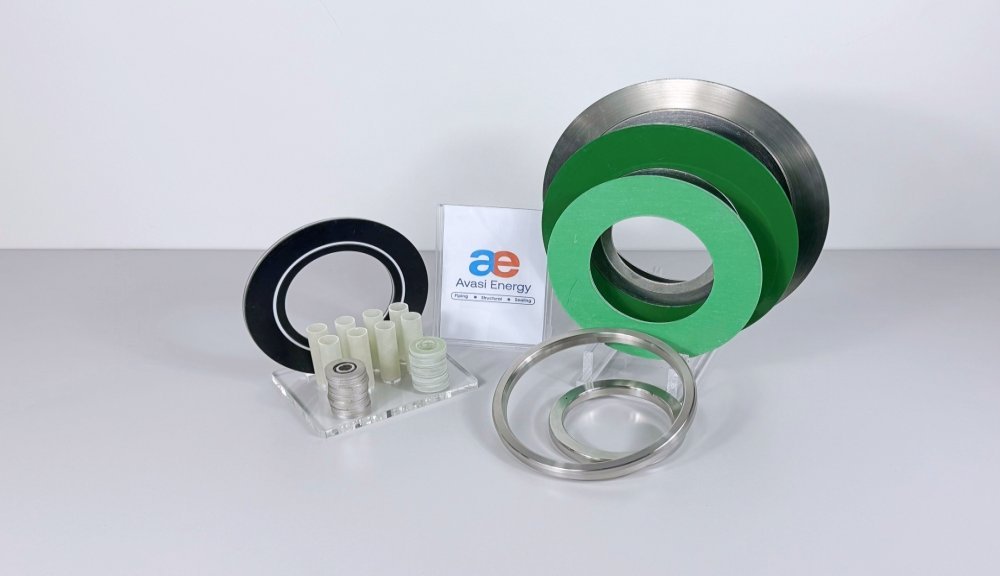
Industrial Gaskets for Reliable Flanged Connections.
Avasi Energy supplies industrial gaskets in Sabah and Malaysia for piping systems, valves, equipment and flanged connections across oil & gas, petrochemical, energy and process industries.
Our sourcing scope includes spiral wound gaskets, ring type joint gaskets, kammprofile gaskets, non-metallic gaskets, graphite and PTFE gaskets, flange insulation sets and selected project-specific sealing solutions.
Requirements are coordinated according to the specified flange standard, size, pressure class, facing, gasket construction, material, filler or sealing element, service conditions, testing and documentation requirements.
Based in Kota Kinabalu, Sabah, Avasi Energy works with manufacturers and supply partners in Malaysia and internationally to support project, maintenance, shutdown and operational requirements.
THE SEAL STARTS WITH THE JOINT.
A Gasket Should Not Be Selected in Isolation.
A gasket forms part of a complete flanged connection.
Its suitability can depend on the relationship between:
- Flange Design
- Facing
- Pressure Class
- Gasket Construction
- Gasket Material
- Process Medium
- Operating Temperature
- Operating Pressure
- Bolting & Assembly Requirements
Two gaskets with the same nominal size may therefore be intended for very different service conditions.
Avasi Energy takes a requirement-first sourcing approach, reviewing the information provided through the customer’s RFQ, piping class, material requisition, datasheet or project specification before coordinating the required gasket.
The right gasket starts with understanding the complete joint.
OUR INDUSTRIAL GASKET RANGE
Different Joints. Different Sealing Requirements.
Spiral Wound Gaskets
Resilient Sealing for Industrial Flange Joints.
Spiral wound gaskets combine alternating metallic winding and soft filler materials to produce a semi-metallic sealing element for industrial flange applications.
Depending on the specified configuration, requirements may involve:
- Outer Centering Ring
- Inner Ring
- Metal Winding
- Graphite or PTFE Filler
- Alternative materials according to service conditions
Common configurations may include styles such as CG, CGI, R and RIR, depending on the applicable flange arrangement and specification.
ASME B16.20 currently covers materials, dimensions, tolerances and markings for spiral-wound metal gaskets used with referenced flange standards.
Avasi Energy sources spiral wound gasket requirements according to the specified size, flange class, winding material, filler material, ring material and applicable standard.
Ring Type Joint — RTJ Gaskets
Metallic Sealing for Grooved Flange Connections.
Ring Type Joint gaskets are metallic sealing rings designed for compatible RTJ flange grooves.
Depending on the applicable flange and project specification, requirements may include:
- Type R — Oval
- Type R — Octagonal
- Type RX
- Type BX
Selection should be based on the correct ring number, ring profile, material and mating flange specification.
ASME B16.20 includes requirements for metal ring-joint gaskets and recognises compatibility with referenced ASME and API flange systems. API 6A also contains dimensional requirements for Type R and BX ring gaskets used in applicable wellhead equipment.
Ring Number Matters.
An RTJ requirement should preferably identify the actual ring designation rather than simply stating the nominal pipe size and pressure class.
Kammprofile Gaskets
High-Integrity Sealing for Demanding Flanged Joints.
Kammprofile gaskets typically combine a machined serrated metal core with soft sealing facings such as graphite or PTFE.
This construction may be specified where the application requires a robust metallic core combined with a conformable sealing layer.
Applications can include selected process piping, heat exchangers, equipment and other demanding flange joints.
Major sealing manufacturers position kammprofile designs for demanding service where joint integrity and recovery are important considerations.
Avasi Energy can coordinate kammprofile gasket requirements according to drawing, flange geometry, core material, facing material and project specification.
Non-Metallic & Soft-Cut Gaskets
Practical Sealing for Suitable Industrial Services.
Non-metallic flat gaskets are used across a broad range of industrial flange applications where the gasket material is compatible with the service and flange arrangement.
Depending on requirements, materials may include:
- Compressed Non-Asbestos Fibre — CNAF
- Graphite
- PTFE
- Elastomeric Materials
- Other project-specified sheet materials
ASME B16.21 covers types, sizes, materials, dimensions, tolerances and markings for non-metallic flat gaskets suitable for referenced flange systems.
Material selection must consider process medium, temperature, pressure, flange type and applicable project specification.
Graphite & PTFE Gaskets
Material Selection Driven by the Service.
Graphite
Graphite-based sealing materials are used in various industrial applications requiring temperature capability and chemical compatibility appropriate to the selected grade and construction.
Graphite may be supplied as sheet material, reinforced gasket construction or as the filler/facing material in semi-metallic gasket systems.
PTFE
PTFE-based gaskets may be specified where chemical resistance and process-medium compatibility are important considerations. Filled, expanded or other engineered PTFE constructions may be specified depending on application.
Global sealing manufacturers offer both graphite and PTFE systems across a wide range of industrial sealing applications. Klinger International
The appropriate grade should follow the customer’s engineering specification or qualified manufacturer’s recommendation.
Flange Insulation Sets
Electrical Isolation Between Flanged Connections.
Flange insulation sets are used where electrical isolation between mating flanges is required as part of the piping or corrosion-control design.
A typical set may include:
- Insulating Gasket
- Insulating Sleeves
- Insulating Washers
- Steel Backing Washers
KLINGER describes flange insulation sets as a means of electrically isolating mating flanges, including for corrosion-control and cathodically protected systems.
Avasi Energy can support flange insulation-set requirements according to flange size, class, facing, insulation type, material construction and project specification.
GASKET + FLANGE + BOLTING
One Joint. Three Connected Components.
A flanged joint does not rely on the gasket alone.
Gasket
Provides the sealing interface between mating flange faces.
Flanges
Define the mating geometry, facing and pressure-rating system.
Explore FlangesStud Bolts & Nuts
Provide the required clamping force according to the applicable joint design and assembly requirements.
Explore Stud Bolts & FastenersGASKET SELECTION MATTERS.
Same Size. Different Service.
A request such as:
4-inch Class 300 gasket
may not contain enough information to identify the correct product.
The complete requirement could also depend on:
| Requirement | Why It Matters |
|---|---|
| Gasket Type | Spiral wound, RTJ, flat, kammprofile or other construction |
| Flange Standard | Determines dimensional compatibility |
| Facing | RF, RTJ, FF or another configuration |
| Pressure Class | Must match the flange system |
| Material | Must suit mechanical and environmental requirements |
| Filler / Facing | Must suit the service medium and temperature |
| Process Fluid | Influences chemical compatibility |
| Temperature | Influences gasket material suitability |
| Pressure | Influences required construction and joint design |
| Project Standard | May specify additional requirements |
We source against the complete sealing requirement — not just diameter and class.
SPIRAL WOUND OR RTJ?
Different Flange Systems Require Different Gaskets.
| Requirement | Spiral Wound | Ring Type Joint |
|---|---|---|
| General construction | Semi-metallic winding + filler | Solid metallic ring |
| Typical mating arrangement | Compatible RF/FF or specified flange arrangements | Machined RTJ groove |
| Key ordering information | Size, class, style, winding, filler, rings | Ring number, profile, material |
| Common governing standard | ASME B16.20 | ASME B16.20 / API requirements where applicable |
| Selection basis | Flange + service conditions | Groove geometry + ring specification |
The correct gasket follows the flange design, piping class and engineering specification.
MATERIAL COMPATIBILITY
The Sealing Material Must Suit the Service.
Gasket material selection should consider both mechanical requirements and process compatibility.
Depending on the gasket type and project specification, Avasi Energy can coordinate requirements involving:
- Metallic Components
- Carbon Steel
- Stainless Steel
- Alloy Steel
- Nickel Alloys
- Soft Iron, for applicable RTJ requirements
- Other project-specified alloys
- Soft Fillers & Facings
- Flexible Graphite
- PTFE
- CNAF
- Elastomeric Materials
- Other engineered sealing materials
The gasket material should not be selected solely because it is commonly available.
Service Comes First. Material Follows.
HIGH-TEMPERATURE, CORROSIVE & SPECIAL SERVICE
When Standard Selection Is Not Enough.
Some piping systems require additional sealing consideration due to service conditions.
Depending on the project specification, requirements may involve:
- High-Temperature Service
- Low-Temperature / Cryogenic Service
- Corrosive Chemicals
- Hydrocarbon Service
- Offshore / Marine Environments
- High-Pressure Service
- Oxygen or Special Gas Service
- Fire-Safe Requirements
- Electrical Isolation
- Cathodic Protection Systems
Different services may require specialised material combinations or manufacturer-qualified products. For example, modern gasket manufacturers now offer dedicated constructions for challenging hydrogen and oxygen services, illustrating how gasket technology is increasingly application-specific rather than purely dimensional.
STANDARDS & SPECIFICATIONS
Built Around Recognised Sealing Requirements.
Depending on gasket type and application, requirements may involve standards including:
ASME B16.20
Metallic gaskets for pipe flanges, including ring-joint, spiral-wound and metal-jacketed gasket requirements. Current ASME listing: 2023 edition.
ASME B16.21
Non-metallic flat gaskets for pipe flanges. Current ASME listing: 2021 edition.
ASME B16.5 / B16.47
Relevant mating flange dimensional systems.
API 6A
Applicable to selected RTJ and wellhead-equipment requirements. API currently maintains the 21st edition with subsequent addenda and errata.
EN / DIN / JIS
Where specified by customer or project standards.
Project-Specific Drawings
For equipment, exchanger and customised gasket applications.
IDENTIFICATION & TRACEABILITY
Know What You Are Installing.
For oil & gas and critical industrial service, identification and traceability are important parts of the supply package.
Depending on the product and project specification, gasket markings or documentation may identify:
- Manufacturer
- Gasket Type
- Nominal Size
- Pressure Class
- Ring Number
- Winding Material
- Filler Material
- Ring Material
- Material Grade
- Applicable Standard
- Heat / Batch Information, where applicable
ASME B16.20 includes marking requirements for metallic gasket types. Industry manufacturer guidance also illustrates identification of size, class, materials and standard on spiral wound gaskets.
Correct Identification Reduces Installation Risk.
TESTING, INSPECTION & DOCUMENTATION
Confidence Beyond the Seal.
Depending on the gasket type, manufacturer capability and project specification, Avasi Energy can coordinate documentation requirements including:
- Material Certificates
- Certificates of Conformity / Compliance
- Material Identification Records
- Dimensional Inspection
- Hardness Testing, where applicable
- PMI, where specified and applicable
- Manufacturer Datasheets
- Product Drawings
- Third-Party Inspection, where required
- Inspection & Test Plan — ITP, where applicable
- Project-Specific Test or Qualification Reports
- Manufacturing Record Book / Data Book, where required
The exact documentation package should be agreed during enquiry review.
TECHNICAL ENOUGH FOR ENGINEERING. CLEAR ENOUGH FOR PROCUREMENT.
Confidence Beyond the Seal.
Engineering teams need confidence that gasket construction, material and flange compatibility align with the service.
Procurement teams need a clear description that can be quoted, compared and ordered without ambiguity.
Avasi Energy bridges both requirements by reviewing the technical information while keeping the sourcing and commercial process straightforward.
Correct specification. Clear quotation. Documented supply.
WHAT TO SEND US FOR AN ACCURATE GASKET RFQ
Help Us Quote the Right Gasket.
For Spiral Wound Gaskets
- Size / NPS
- Pressure Class
- Flange Facing / Standard
- Gasket Style
- Winding Material
- Filler Material
- Inner Ring Material
- Outer Ring Material
- Quantity
For RTJ Gaskets
- Ring Number
- R / RX / BX Type
- Oval or Octagonal, where applicable
- Material
- Applicable Standard
- Quantity
- For Flat / Non-Metallic Gaskets
- Size
- Pressure Rating / Flange Standard
- Full Face or Ring Type
- Material / Grade
- Thickness
- Quantity
For Project Requirements
- Process Medium
- Design / Operating Temperature, where relevant
- Design / Operating Pressure, where relevant
- Testing or Inspection Requirements
- Documentation Requirements
- Required Delivery Date
Where available, attach:
- RFQ
- Piping Class
- Material Requisition
- Datasheet
- Drawing
- Project Specification
Example Ordering Descriptions
Spiral Wound Example
4" Class 300 Spiral Wound Gasket, CGI, SS316L Winding, Graphite Filler, SS316L Inner Ring, CS Outer Ring, ASME B16.20
RTJ Example
R-39 RTJ Gasket, Octagonal, Soft Iron, ASME B16.20
Examples only. Final description must follow the customer’s project specification.
FROM REQUIREMENT TO DELIVERY
A Focused Supply Process.
- Review
- We review the required pipe specification, grade, dimensions, quantity, testing and documentation requirements.
- Source
- Suitable manufacturers and supply sources are identified according to the stated requirement.
- Technical Compliance
- The proposed pipe is reviewed against the agreed technical and commercial scope.
- Inspection & Documentation
- Required certification, testing and inspection documentation is coordinated where included within the supply scope.
- Delivery Coordination
- Final documentation and delivery requirements are coordinated through order completion.
Specification Reviewed. Supply Coordinated. Documentation Aligned.
SUPPORTING SABAH’S INDUSTRIAL REQUIREMENTS
Based in Sabah. Connected Beyond Sabah.
Avasi Energy is based in Kota Kinabalu, Sabah, supporting pipe and piping-material requirements for customers, projects and industrial operations in East Malaysia.
Our local presence is supported by access to manufacturers and supply partners in Malaysia and internationally, allowing us to coordinate requirements according to project specifications rather than restricting customers to a single source or product range.
This positioning is increasingly relevant as Sabah’s OGSE ecosystem develops. PETRONAS reported in February 2026 that contracts secured by recognised Sabah-based OGSE vendors had grown substantially since 2021.
We support requirements associated with:
- Oil & Gas
- Petrochemical & Process
- Energy
- Offshore & Onshore Projects
- Maintenance & Shutdowns
- Brownfield Modifications
- Replacement Requirements
Local Presence. Wider Sourcing Capability.
COMPLETE THE FLANGED JOINT
Need the Flanges and Bolting Too?
Avasi Energy also supplies complementary piping products:
Pipe FittingsElbows, tees, reducers, caps, forged fittings and branch connections.
FlangesWeld neck, blind, slip-on and other project-specified flange configurations.
PipesCarbon steel, stainless steel, alloy and project-specific piping requirements.
Stud Bolts & FastenersLine BlanksRestriction OrificesFREQUENTLY ASKED QUESTIONS
What information is required to quote a spiral wound gasket?
The key information generally includes size, pressure class, applicable flange standard, gasket style, winding material, filler material, ring materials, quantity and required documentation.
What is the difference between a spiral wound gasket and an RTJ gasket?
A spiral wound gasket uses metallic winding combined with a soft filler, while an RTJ gasket is a metallic ring designed to fit a compatible machined flange groove. Selection follows the flange system and project specification.
What is the difference between RF and RTJ gasket requirements?
Raised-face flange arrangements and ring-type-joint flange arrangements use fundamentally different sealing interfaces. A gasket designed for an RF connection should not be assumed suitable for an RTJ groove.
Can Avasi supply graphite and PTFE gaskets?
Yes, Avasi can source graphite, PTFE and other industrial gasket materials according to the required grade, construction, service conditions and manufacturer availability.
Can Avasi supply flange insulation kits?
Yes. Requirements can be coordinated according to flange size, pressure class, insulation-system construction and project specification.
Can Avasi supply API 6A RTJ gaskets?
Avasi can coordinate project-specific RTJ requirements associated with applicable API 6A flange systems, subject to ring type, material, specification and qualified manufacturer availability.
Looking for Industrial Gaskets?
Send Avasi Energy your RFQ, piping class, material requisition, datasheet, flange details or project specification.
Whether your requirement involves spiral wound, RTJ, kammprofile, graphite, PTFE, non-metallic or flange insulation gaskets, our team will review the requirement and coordinate suitable sourcing options according to the stated technical, documentation and delivery requirements.
AVASI ENERGY SDN BHD
Piping. Flow Control. Smarter Sourcing.